 En
En  Da
Da
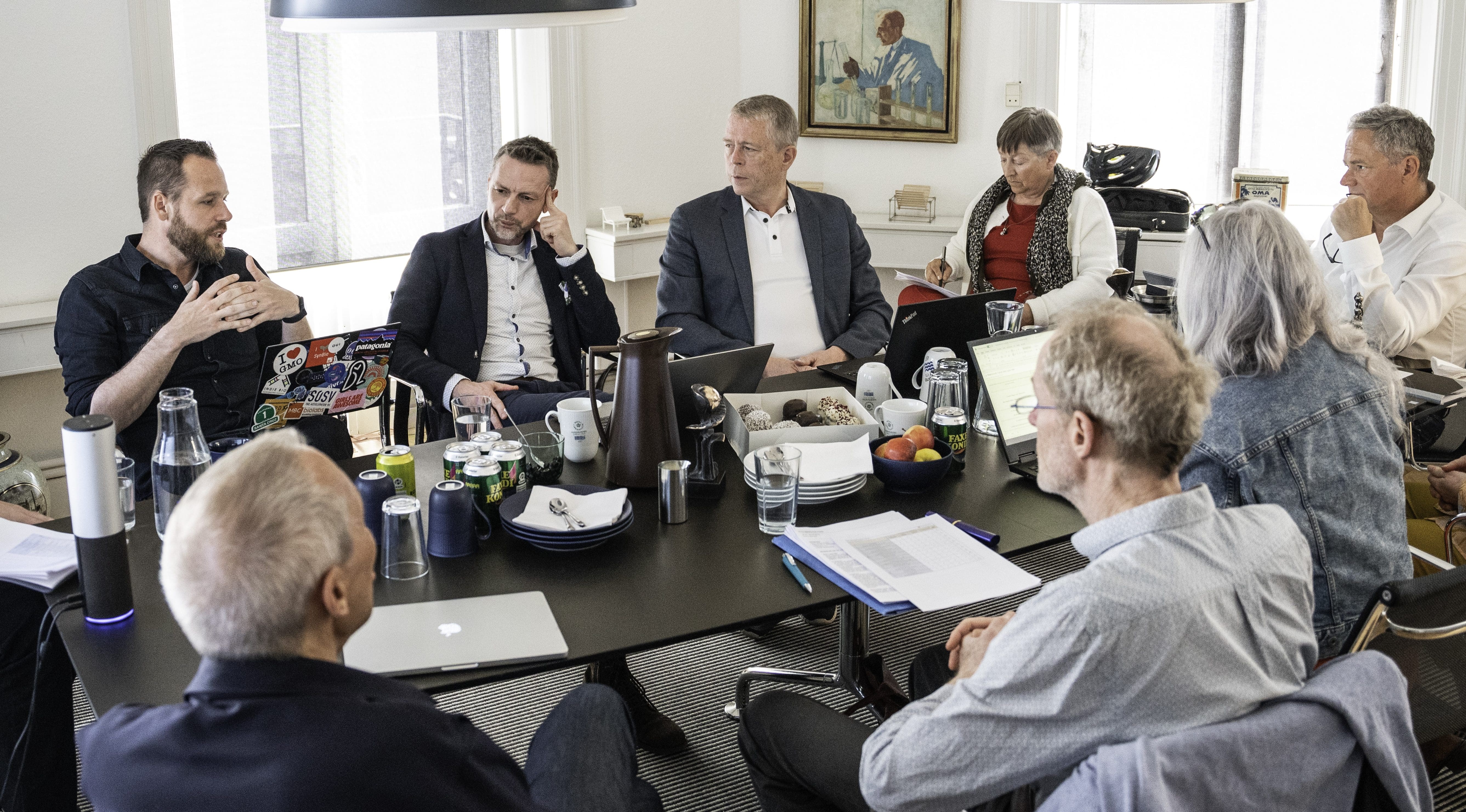
For both the applicants and Christian Brix Tillegreen, serving on the jury behind The Bright Idea is a win-win.
When Christian Brix Tillegreen goes to lunch in the canteen, there could easily be a burger with a MATR mushroom steak on the menu. Because both the catering industry and the grocery trade have a taste for alternatives to meat. As head of the Planetary Health department at the BioInnovation Institute (BII), Christian Brix Tillegreen has been closely involved with MATR as one of the 20-30 projects a year that receive generous grants from BII to further develop impact projects into actual companies. And he tells us with joy in his voice that MATR is currently building a factory with at least 40 million euros from the European Investment Bank and Novo Holdings behind it.
The BioInnovation Institute has given 140 companies significant support in the form of accelerator programmes, business development, grants and access to facilities since the Novo Nordisk Foundation founded BII almost seven years ago. Christian Brix Tillegreen estimates that the bridging between academia and the market that BII practices on a daily basis has created around 1000 jobs during this period.
Moneyed talent scout in the prize jury
Since the Novo Nordisk Foundation announced in January that it is allocating an additional DKK 5.5 billion to accelerate the activities of BII, Christian and his colleagues can look forward to intensifying interest in new innovative discoveries.
Christian is a member of the jury that judges the applications for the Otto Mønsted Foundation’s Bright Idea Award every year. It’s a win-win for both the award applicants and BII to have Christian on the jury in his role as an expert in biotech and especially planetary health with a focus on green innovation – and as a talent scout.
“With the Novo Nordisk Foundation’s donation, BII will be able to do even more of what we already do over the next ten years, so I really need to find some bright ideas. And being part of The Bright Idea means that I get to spot some ideas very early on and hopefully help create the next bridge for them. Many of the ideas submitted to The Bright Idea are early ideas. But there are many of them where I just make a note that here’s an idea I should keep an eye on, because it may well be ready after some time.”
It is important to note that no ideas are shared without the applicants’ consent and that the rules for sharing knowledge are of course respected.
Prize winner is moving on
That Christian as a jury member might be able to push bright ideas forward seems to be the case for one of the award winners in 2025.
As the winner of The Bright Idea 2025 in the early-stage category, BioNa, headed by Thomas Howard, did not “just” go home with a prize of DKK 250,000 to further develop their technology. Since the award ceremony on 5 November in Copenhagen, there has been a dialogue that is likely to be followed up soon when the deadline for BII’s next application round approaches. There is no doubt that there are interesting sustainable and global perspectives in BioNa’s technology that converts plant waste into biochar in CO₂-negative battery anodes as an alternative to lithium.
“This year’s winner, BioNa and Thomas Howard, is a project that is simmering at DTU. I have a strong feeling that BioNa will land in my office before too long. Here we will be able to give BioNa a proper commercial kick as a spin-out. That’s very much what we do – taking bright ideas, helping them out of the academic environment and actually making a company,” says Christian.
Why they were winners in 2025
The Bright Idea as a springboard
He believes that there is more diversity in the applications for the Bright Idea and the quality has improved in recent years.
“It’s a good sign that more disciplines are thinking about entrepreneurship. Perhaps researchers are also starting to see the Bright Idea as a stepping stone. That’s often what happens with these types of grants. It creates awareness of the projects.”
Christian is also a member of Innovation Fund Denmark’s Grand Solutions committee for green transition and has a good insight into how innovation and money flows in Denmark.
“We have a very good innovation chain in Denmark. It can start with you winning The Bright Idea. That award will often help you move on to an Innofounder or Innoexplorer. Then you might come to us at BII and get, for example, four million and afterwards you might apply for an Innobooster at Innovation Fund Denmark. Suddenly you have enough money to go after some of the European innovation funds and maybe attract DKK 20-30 million in capital. And that’s probably what we need when we need to create companies that are a little heavier on technology and can’t hit the market as quickly as, for example, an app can.”
Whether you win The Bright Idea or not, the process of writing an application is in itself an important exercise in translating your idea into thoughts that a jury can relate to and see as a future business with potential. A company like MATR would probably also recommend this as useful training.
Christian’s tips for applicants
- Be clear on how your idea differentiates itself from something existing
- How does it speak to the industry it’s targeting?
- Focus on understanding the problem you want to solve
The 2025 winners talk about their ideas
The application period for The Bright Idea 2026 is from 15 April to 15 August 2026.