 En
En  Da
Da
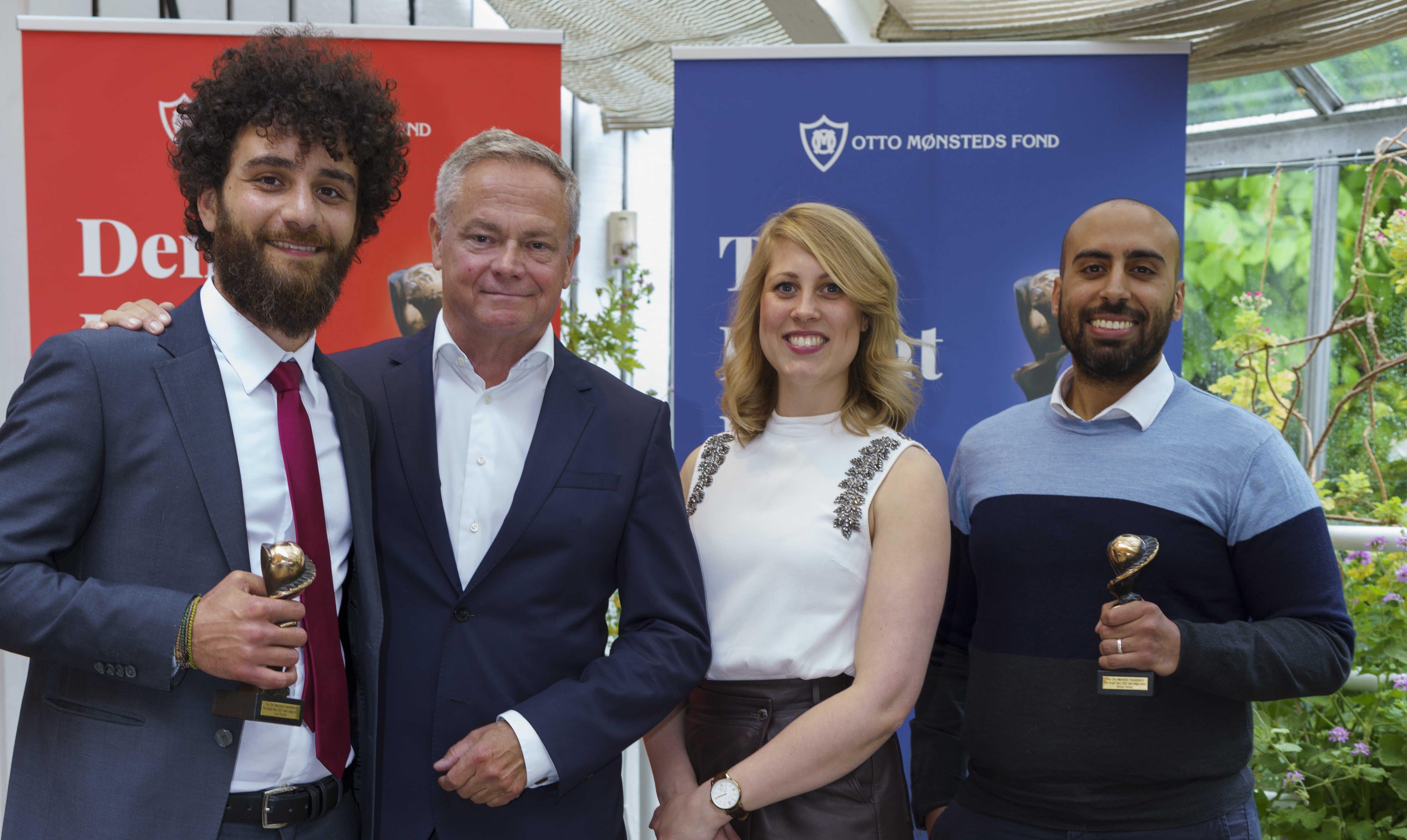
The Otto Mønsted Foundation has once again awarded the Bright Idea Award and a total of DKK 600,000 to three researchers to further develop their dazzling ideas that promote the development of hydrogen cars, LED and circular construction.
On Wednesday 25 May, the Otto Mønsted Foundation was once again delighted to announce the winners of the Bright Idea 2022 competition. For the fourth year in a row, the prize is awarded to honour some of the country’s talented entrepreneurs and give them financial support to develop their innovative bright ideas.
The Bright Idea 2022 award was presented in two categories – Best Late-stage Idea and Best Early-stage Idea. The winners of the two categories each received DKK 250,000 for their ideas, which are classified in a mature or early stage of development.
All of this year’s submissions were judged by a jury that thoroughly evaluated all submissions based on excellence in thought, communication, analysis and documentation. In addition, an idea must demonstrate commercial vision and understanding to support the foundation’s charter and create value for Danish trade and industry. Finally, the jury assesses the likelihood that the idea can be implemented and the value and significance of the idea for the Danish business community.
Bright ideas for hydrogen technology and lighting
The winner of the best idea in the Late-stage category was Ahmed Ammar, postdoc at the Department of Electrical Engineering at DTU.

Ahmed Ammar has prototyped an LED driver that is both significantly smaller and extremely efficient compared to existing ones. These advantages open up a number of new applications for LED as a light source and will make a significant contribution to the green transition. The award winner has been thinking commercially from the beginning and is currently affiliated with the university’s innovation hub, from where he will establish a company to commercialise the new generation of LED drivers.
The winner in the Early-stage category was Luca Piccirilli, PhD student at the Department of Chemistry, DTU.

Luca Piccirilli has developed a solution to a fundamental problem in the use of hydrogen as “fuel” in cars. Hydrogen is a gas and needs to be attached to a carrier molecule to become liquid. But it is only hydrogen that is used in a hydrogen-based fuel cell that produces electricity for cars. The prize winner has developed a system where hydrogen and carrier molecules are separated from each other again – using only the heat created when the hydrogen is consumed in the fuel cell. Thus, no additional large amounts of energy are needed to release hydrogen from the carrier molecules. Luca Piccirilli’s new system therefore contributes to an unprecedented energy optimisation of hydrogen that brings hydrogen much closer to commercial exploitation, and he has a commercial partner.
Extraordinary runner-up award this year
Extraordinarily this year, the jury chose to award a runner-up prize of DKK 100,000 to Jannike Borg, MSc student at the Department of Business Development and Technology at Aarhus University.

Jannike Borg, together with her father, a carpenter, has developed building structures made of wood-based materials that are both circular and can decompose in nature without negative impact on the environment. Jannike Borg’s research shows potential for a significant CO2 reduction and better indoor climate in a one-family house. Jannike Borg’s project is a good example of combining research and craftsmanship. The jury found the idea so interesting and solid that a runner-up award should be given to Jannike Borg this year.
Strong focus on sustainability this year
This year’s winning ideas all contribute to solutions that promote the green transition, but have been realised differently and for different industries. The green focus has generally been prominent in this year’s submitted applications, says the chairman of the Otto Mønsted Foundation, Nis Alstrup:
“Fortunately, there is a focus on sustainability among many applicants. It is very positive and incredibly reassuring for future generations that our young researchers take sustainability and green transition so seriously, and as we know, it is unfortunately also imperative.

This year’s winning ideas have a global perspective on the green transition and contribute in their own way to maintaining Denmark’s position as one of the world’s leading exporters of green solutions that benefit the whole world and future generations. We must live off our bright minds and the ability to translate their knowledge into business for the benefit of Danish society and industry. Completely in the spirit and vision of Otto Mønsted for the foundation’s work.”
Candidates for ‘The Bright Idea’ are generally bachelor/graduate students, PhD students, postdocs and entire research teams affiliated with one of Denmark’s eight universities.
This year’s jury
All this year’s nominations are evaluated by an award jury consisting of:
Kigge Hvid, partner, JA studio
Ole Kring, partner, VF Venture (Vækstfonden)
Bjarne Kjær Ersbøll, Professor DTU Compute and member of the board of the Otto Mønsted Foundation
Jesper Højberg Christensen, adjunct professor at CBS
Nis Alstrup, Chairman of the Board of the Otto Mønsted Foundation
Karina Bergstrøm Larsen, Director, Q-Consulting
Christian Brix Tillegreen, Senior Business Developer, Bioinnovation Institute
Nigel Edmondson, CEO, MADE
Vibeke Svendsen, board member of the Otto Mønsted Foundation
The jury’s reasons
Winner of The Bright Idea 2022 – Late stage: Ahmed Ammar, postdoc at the Department of Electrical Engineering, DTU.
The jury’s motivation:
LED light is the light of the future, which is already part of our everyday lives. This year’s winner solves the problem that LED lights need to be powered by a direct current source and what comes out of the socket is alternating current. Therefore, a more or less clumsy LED driver is often included as part of the solution when using LED as a light source. This year’s winner solves this problem by developing an LED driver that is both significantly smaller and extremely efficient. This opens up a number of new applications for LED as a light source, saving additional energy and making a significant contribution to the green transition.
Ahmed Ammar has been thinking commercially from the start and is currently affiliated with DTU Skylab, where his ambition is to start a company to commercialise the idea.
Winner of The Bright Idea 2022 – Early-stage: Luca Piccirilli, PhD student at the Department of Chemistry, DTU.
The jury’s motivation:
This year’s winner offers a solution to a fundamental problem by using hydrogen as part of the green transition. He has elegantly created a system where hydrogen that is attached to a carrier molecule to create a liquid fuel can be recovered as hydrogen again – simply by utilising the heat created when hydrogen is consumed in the fuel cells. Thus, massive amounts of energy do not need to be added to release the hydrogen, bringing hydrogen much closer to commercialisation.
Luca has been thinking commercially from the start, and today he has both patented his invention and acquired a commercial partner with the muscle to realise his idea into a commercial product in a market that will cover 25% of global energy consumption by 2050.